
Resources
Find help or explore a topic.
Crisis contacts, community services, and visual guides. Choose what you need.
Explore resources
Urgent helpCrisis contacts in Canada, and guidance for other locations.
Urgent help in Canada
Outside Canada, contact your local emergency or crisis service.
Suicide crisis support
988Call or text 988 in Canada, 24 hours a day. Support is also available if you’re worried about someone else.
Visit 9-8-8Kids Help Phone
1-800-668-6868Support for young people. Call any time, or text CONNECT to 686868.
Explore youth supportDigital workbookFour short activities. Turn your choices into a picture or find a phrase.
Free digital workbook
Ally GuideEveryday support for Two-Spirit and LGBTQIA+ people.
Visual guides & activitiesGrounding, feelings, boundaries, and more.
Explore in your own way.
See, read, listen or try an activity. Switch whenever you like.
Visual guides
Choose a topic, then explore it in the format you prefer.
Download North Aster guides (10-page PDF)Overwhelm and grounding2 guides
North Aster guide
Find one anchor
Choose one thing to notice. You can stop at any time.
Read-aloud needs an English voice installed on this device and a supported browser. You can also use the text below or your device's reading tools.
Read the guide
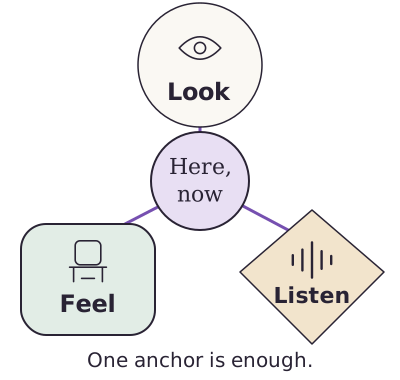
Look. Name one thing you can see.
Feel. Notice the chair or surface supporting you.
Listen. Notice one sound around you.
No need to do all three. If this feels uncomfortable, pause or choose something else.
Look. Name one thing you can see.
Feel. Notice the chair or surface supporting you.
Listen. Notice one sound around you.
No need to do all three. If this feels uncomfortable, pause or choose something else.
About this guide and source
Original North Aster prompts, informed by VA Whole Health guidance on noticing a present-moment sensory anchor.
VA Whole Health: Sensation of groundingNorth Aster guide
When input is too much
Try one change that feels comfortable for you.
Read-aloud needs an English voice installed on this device and a supported browser. You can also use the text below or your device's reading tools.
Read the guide
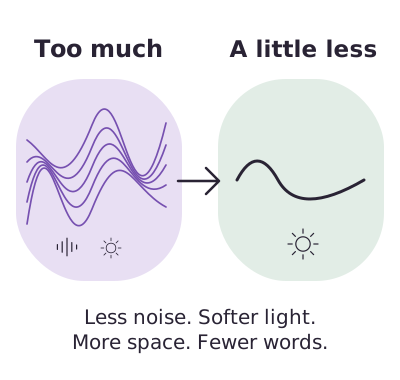
Noise. A quieter space or less audio
Light. Softer lighting
Touch. More personal space or comfortable clothing
Talking. A pause, or one question at a time
Different people need different things. You can ask for a change without explaining everything.
Noise. A quieter space or less audio
Light. Softer lighting
Touch. More personal space or comfortable clothing
Talking. A pause, or one question at a time
Different people need different things. You can ask for a change without explaining everything.
About this guide and source
Original North Aster comparison, informed by sensory adjustments described by the National Autistic Society. This guide does not identify or diagnose autism.
National Autistic Society: Sensory processingFeelings and needs1 guide
North Aster guide
Words for what you need
Try any part of this. An exact label is optional.
Read-aloud needs an English voice installed on this device and a supported browser. You can also use the text below or your device's reading tools.
Read the guide
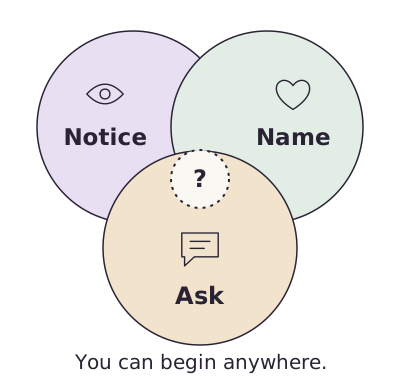
Notice. What is happening for me? Examples: Tense / heavy / restless / unsure.
Name, if you can. What feeling comes closest? Examples: Worried / sad / angry / mixed.
Ask. What might help right now? Examples: Quiet / company / time / practical help.
There is no fixed link between a feeling and a need. "I'm not sure, but I need support" is enough.
About this guide and source
Original North Aster communication prompt. Further reading from Mind is written for ages 11-18; this prompt is not an assessment or a validated emotion scale.
Mind: Understanding your feelings (ages 11-18)Personal boundaries2 guides
North Aster guide
A boundary, in your words
A short sentence can make your limit clear.
Read-aloud needs an English voice installed on this device and a supported browser. You can also use the text below or your device's reading tools.
Read the guide
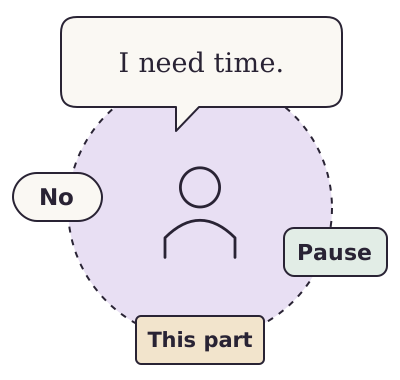
Say no. I'm not available tonight.
Take time. I need time before I answer.
Set a limit. I can help with this part.
If stating a boundary could put you at risk, seek support with safety planning first.
Say no. I'm not available tonight.
Take time. I need time before I answer.
Set a limit. I can help with this part.
If stating a boundary could put you at risk, seek support with safety planning first.
About this guide and source
Original North Aster examples, informed by the Centre for Clinical Interventions' assertiveness resources. No worksheet or publisher artwork has been reproduced.
Centre for Clinical Interventions: AssertivenessTypes of boundaries
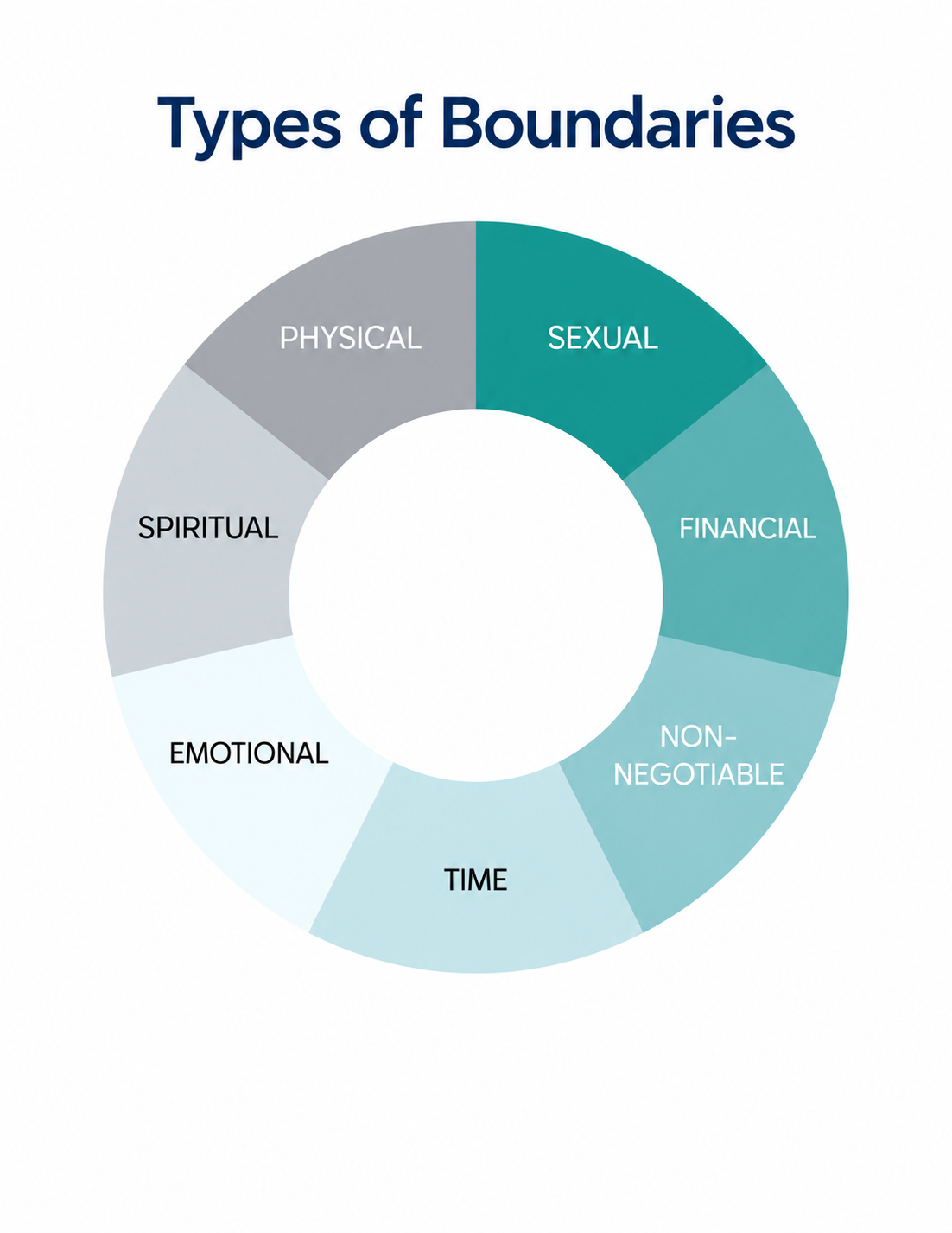
Seven areas to reflect on when thinking about your own boundaries.
Read-aloud needs an English voice installed on this device and a supported browser. You can also use the text below or your device's reading tools.
The wheel names seven areas of boundaries: physical, sexual, financial, non-negotiable, time, emotional, and spiritual.
Scroll to read. Uncheck “Enlarge image” to fit the page.
Read text summary
The wheel names seven areas of boundaries: physical, sexual, financial, non-negotiable, time, emotional, and spiritual.
Supporting someone1 guide
North Aster guide
Be with someone in distress
You do not need to solve everything to offer support.
Read-aloud needs an English voice installed on this device and a supported browser. You can also use the text below or your device's reading tools.
Read the guide
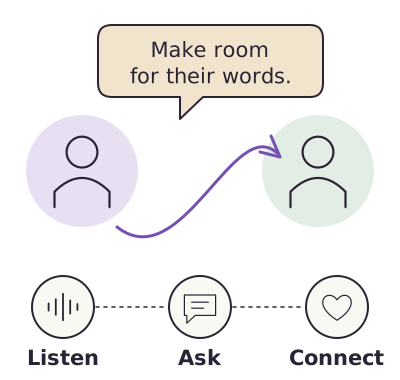
Listen. Give them space to speak. Avoid judging or rushing to advice.
Ask directly. If you are worried about suicide, ask: "Are you thinking about suicide?"
Connect with help. In Canada, either of you can call or text 9-8-8, any time.
Immediate danger or serious injury: call 911 in Canada. Elsewhere, use local emergency or crisis services.
About this guide and source
Original North Aster layout and summary of 9-8-8 Canada's guidance. The direct question about suicide is quoted from that guidance.
9-8-8 Canada: Talk to someone you are worried aboutGrief and loss1 guide
North Aster guide
Grief has no fixed order
Feelings can change, overlap or return. There is no timetable to follow.
Read-aloud needs an English voice installed on this device and a supported browser. You can also use the text below or your device's reading tools.
Read the guide
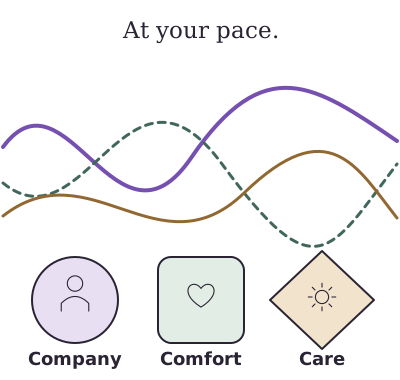
Company. Ask someone to sit with you, with or without talking.
Comfort. Choose a familiar ritual, memory or quiet activity.
One basic need. Make room for a drink, food or a rest.
These are options, not stages. Support is available whenever grief feels too much to carry.
Company. Ask someone to sit with you, with or without talking.
Comfort. Choose a familiar ritual, memory or quiet activity.
One basic need. Make room for a drink, food or a rest.
These are options, not stages. Support is available whenever grief feels too much to carry.
About this guide and source
Original North Aster options, informed by CAMH's discussion of individual and cultural differences in grief, everyday care and reaching out for support.
CAMH: Loss, grief and healingAsking for support1 guide
North Aster guide
A first message is enough
You can start with a few words.
Read-aloud needs an English voice installed on this device and a supported browser. You can also use the text below or your device's reading tools.
Read the guide
Try this. I'm having a hard time. Can you help me find a next step?
If you want, add. What you need: a conversation, counselling or help finding services.
Contact North Aster. hello@northaster.com
Counselling: within Canada, subject to suitability and local requirements. Support and navigation: internationally. Email is not monitored for emergencies.
About this guide and source
Original North Aster wording, based on the service scope confirmed by the owner: counselling within Canada; support and navigation internationally. See the website's Contact page for current details.
North Aster: Contact and service scopeUnderstanding abuse2 guides
Types of abuse
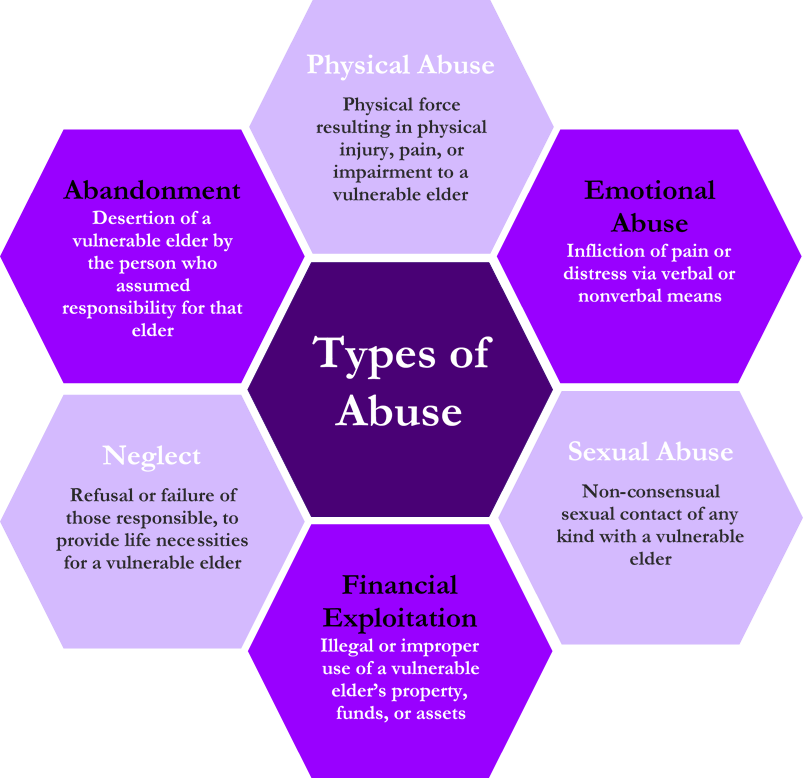
Six forms of abuse, with examples focused on older adults.
Read-aloud needs an English voice installed on this device and a supported browser. You can also use the text below or your device's reading tools.
The chart identifies six forms of abuse: physical abuse, emotional abuse, sexual abuse, financial exploitation, neglect, and abandonment. Its definitions focus on vulnerable older adults and include harm, non-consensual contact, misuse of money or property, unmet necessities, and desertion by a responsible caregiver.
Scroll to read. Uncheck “Enlarge image” to fit the page.
Read text summary
The chart identifies six forms of abuse: physical abuse, emotional abuse, sexual abuse, financial exploitation, neglect, and abandonment. Its definitions focus on vulnerable older adults and include harm, non-consensual contact, misuse of money or property, unmet necessities, and desertion by a responsible caregiver.
The cycle of abuse
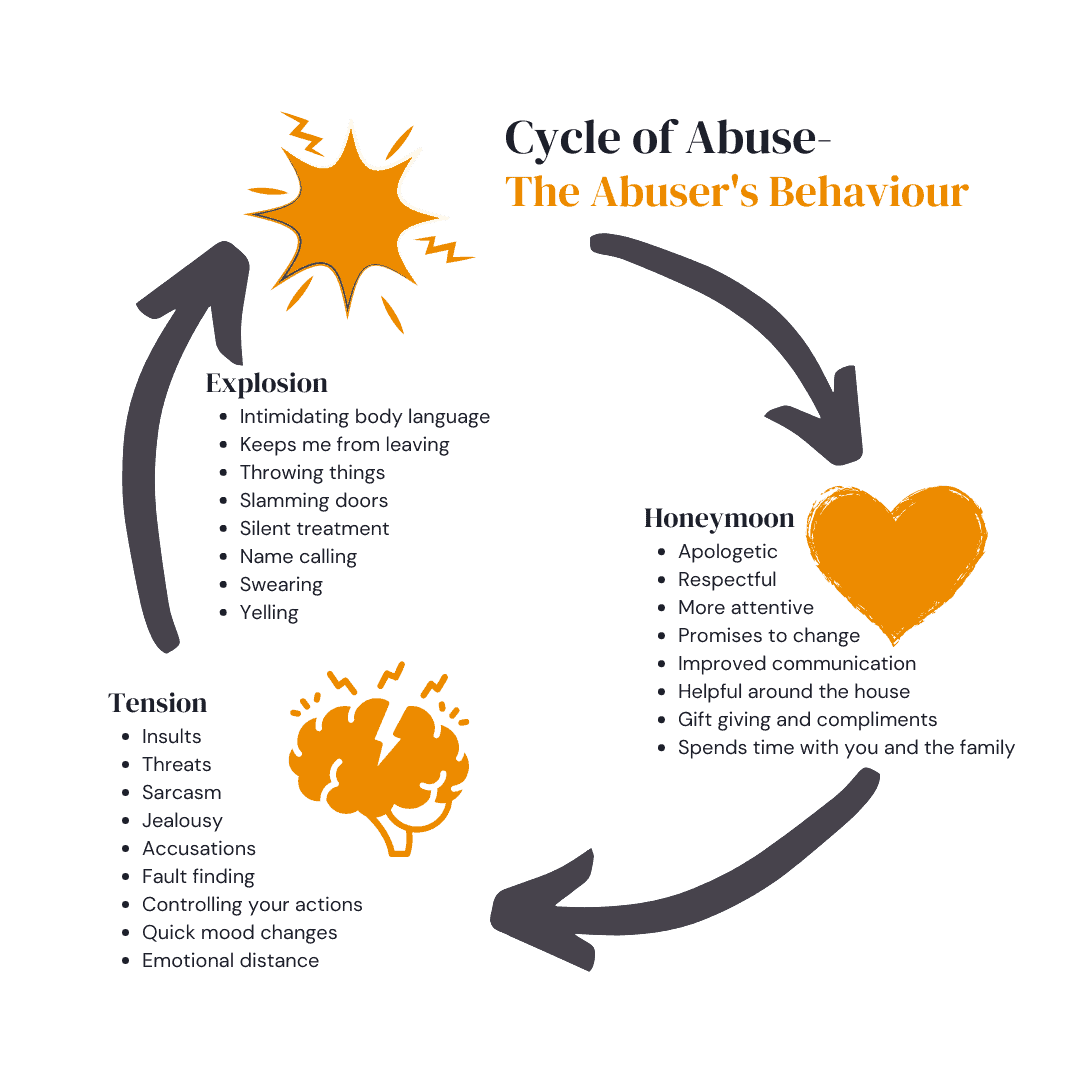
A diagram of the abuser’s behaviour across three recurring stages.
Read-aloud needs an English voice installed on this device and a supported browser. You can also use the text below or your device's reading tools.
The diagram moves from honeymoon to tension to explosion, then back to honeymoon. Honeymoon examples include apologies, attention, and promises to change. Tension examples include threats, jealousy, control, and emotional distance. Explosion examples include intimidation, preventing someone from leaving, throwing things, and yelling.
Scroll to read. Uncheck “Enlarge image” to fit the page.
Read text summary
The diagram moves from honeymoon to tension to explosion, then back to honeymoon. Honeymoon examples include apologies, attention, and promises to change. Tension examples include threats, jealousy, control, and emotional distance. Explosion examples include intimidation, preventing someone from leaving, throwing things, and yelling.
Childhood experiences (ACEs)2 guides
Conventional and expanded ACEs
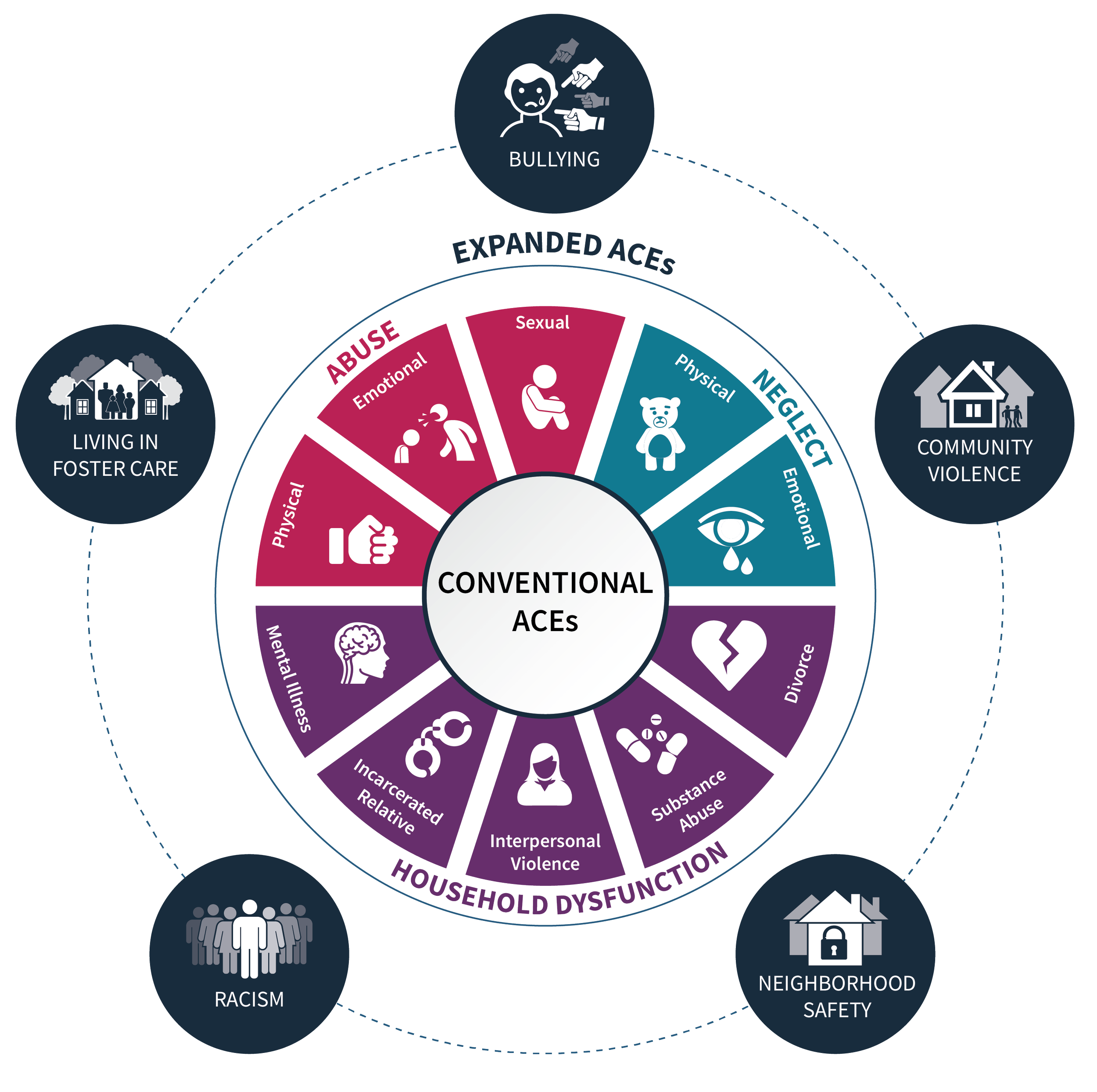
A visual overview of adverse childhood experiences (ACEs).
Read-aloud needs an English voice installed on this device and a supported browser. You can also use the text below or your device's reading tools.
The inner wheel groups conventional ACEs under abuse, neglect, and household dysfunction. It includes physical, emotional, and sexual abuse; physical and emotional neglect; and household experiences involving mental illness, an incarcerated relative, interpersonal violence, substance abuse, and divorce. The expanded outer ring adds bullying, community violence, neighbourhood safety, racism, and living in foster care.
Scroll to read. Uncheck “Enlarge image” to fit the page.
Read text summary
The inner wheel groups conventional ACEs under abuse, neglect, and household dysfunction. It includes physical, emotional, and sexual abuse; physical and emotional neglect; and household experiences involving mental illness, an incarcerated relative, interpersonal violence, substance abuse, and divorce. The expanded outer ring adds bullying, community violence, neighbourhood safety, racism, and living in foster care.
ACEs at a glance
The original illustrated table of abuse, neglect, and household experiences.
Read-aloud needs an English voice installed on this device and a supported browser. You can also use the text below or your device's reading tools.
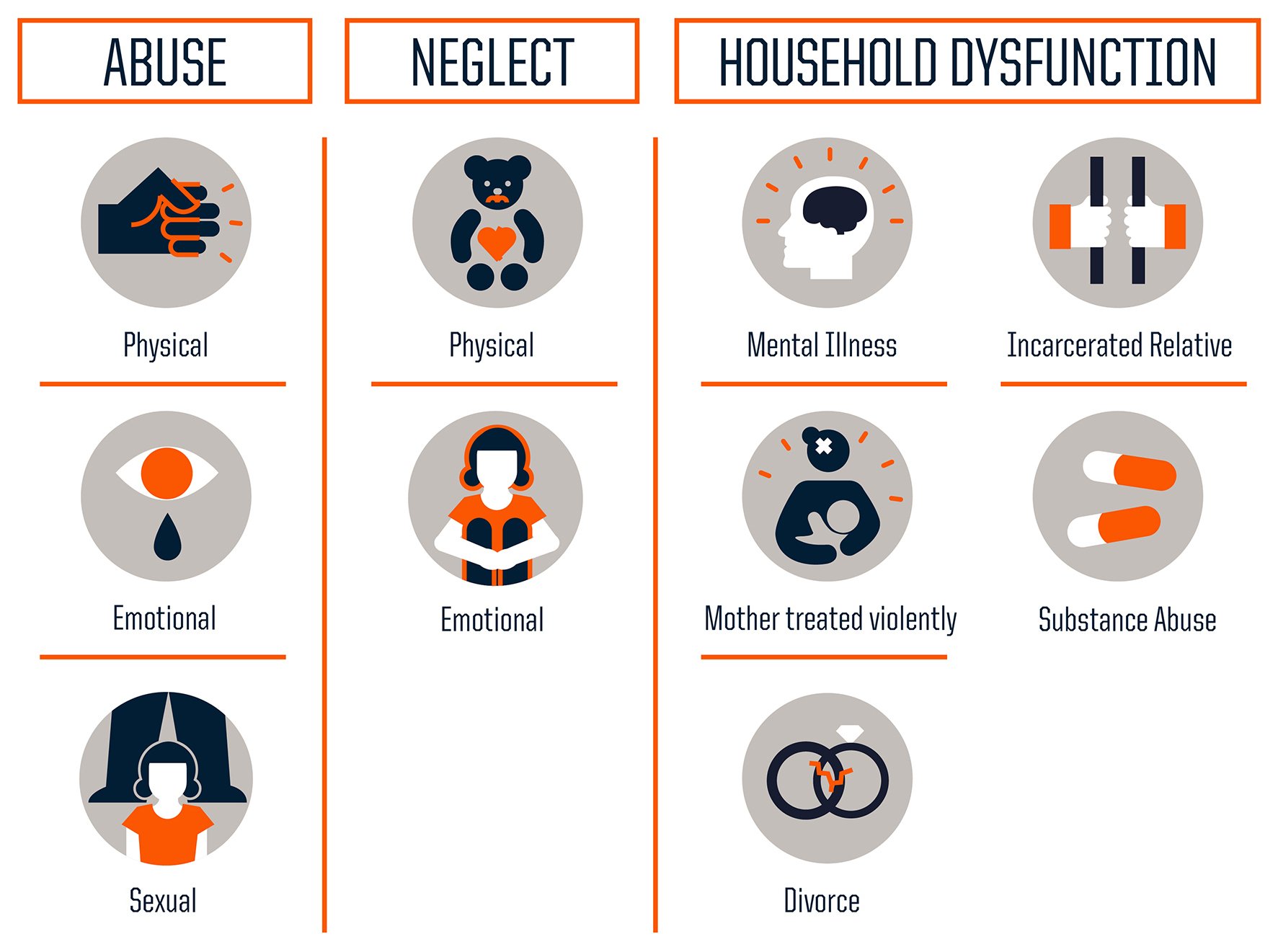
The table groups physical, emotional, and sexual abuse in one column; physical and emotional neglect in a second; and mental illness, an incarcerated relative, a mother being treated violently, substance abuse, and divorce under household dysfunction.
Scroll to read. Uncheck “Enlarge image” to fit the page.
Read text summary
The table groups physical, emotional, and sexual abuse in one column; physical and emotional neglect in a second; and mental illness, an incarcerated relative, a mother being treated violently, substance abuse, and divorce under household dysfunction.
Understanding addiction1 guide
The cycle of addiction
A visual framework for reflecting on recurring patterns.
Read-aloud needs an English voice installed on this device and a supported browser. You can also use the text below or your device's reading tools.
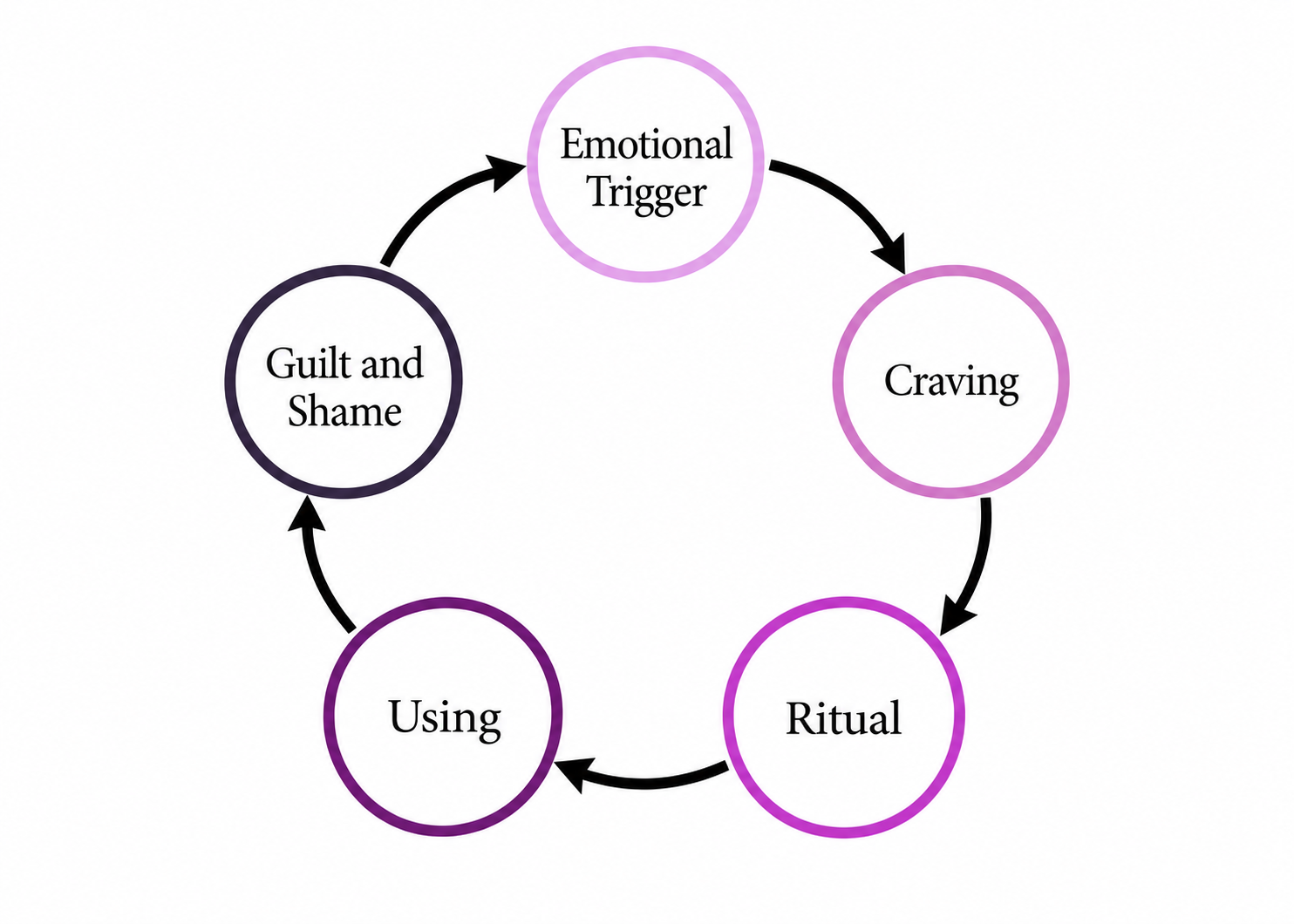
The diagram follows a repeating loop: emotional trigger, craving, ritual, using, then guilt and shame, returning to the emotional trigger.
Scroll to read. Uncheck “Enlarge image” to fit the page.
Read text summary
The diagram follows a repeating loop: emotional trigger, craving, ritual, using, then guilt and shame, returning to the emotional trigger.
Try a small activity
Explore an idea by doing
Try an everyday object, a sketch, or a few words. Choose whatever feels useful today.
Read-aloud needs an English voice installed on this device and a supported browser. You can also use the text below or your device's reading tools.
Find one detail
Choose something nearby: a familiar object, clothing, or a surface supporting you. Notice one edge, texture, or point of contact.
You can look, touch, or simply notice where you are. No special object is needed.
Give an idea a shape
Use a line, shape, word, or two objects to represent what is on your mind. Add or choose one thing that stands for what you need.
Drawing is optional. Arranging words or objects works too.
Try a phrase privately
Choose a phrase such as “I need a moment” or “Could you help me with this?” Say it, write it, sign it, or use your usual communication aid.
If using a phrase with someone could put you at risk, seek support with safety planning first.
There is no sequence to finish. Skip any option, adapt it, or stop.
About these activities
Original North Aster exploration prompts. Noticing draws on grounding guidance; practising a phrase draws on assertive communication. The sketch prompt is an optional creative exercise, not an assessment or treatment.
VA Whole Health: Sensation of groundingCentre for Clinical Interventions: AssertivenessThese guides offer information and optional prompts. Sources are included with each new guide.
More on childhood experiences: understanding ACE scores (Stop Abuse Campaign).
Back to all resource categoriesNeurodivergence & disabilityEveryday support, learning, work, rights, and access.
Neurodivergence & disability
Explore support for everyday life. Choose a topic to see a few starting points.
Sensory needs & everyday support
2 resources
-
Welcome to the Autistic Community
Autistic Self Advocacy Network
A plain-language introduction to autism, identity and self-advocacy, written by autistic people.
-
Sensory differences and support
National Autistic Society
Explore sensory differences and ways to make everyday environments more comfortable.
Learning & work
2 resources
Rights, benefits & navigation
2 resources
Recreation & community life
2 resources
-
Plan an accessible theatre visit
Neptune Theatre
Check wheelchair access, hearing supports and dates for relaxed, interpreted or audio-described performances.
-
Find accessible shows in New York
Theatre Access NYC
Search shows by access needs, including captioning, audio description and wheelchair access.
Check the venue’s current access details before booking.
Community directoryFind organizations by the kind of support you need.
Community directory
Choose a topic. Each organization’s website explains its services and how to get in touch.
Mental health services in HRM
More mental health support
2SLGBTQI+ resources
BIPOC community resources
Crisis and support services
Autism resources
Shelter and housing
Community and daily needs


Need help choosing or contacting a service? Ask about navigation support.